The English-language chemistry examination for Plovdiv Medical University contains the following entrance examination syllabus.
The candidate should be prepared for the following:
GENERAL CHEMISTRY
Atomic structure Atomic number, atomic nucleus, atomic mass, isotopes and isobars. Electronic structure of the atom – energy levels, characteristics of s-, pan- d-orbitals. Electronic configuration and orbital diagram of the elements of I and II period of the periodic table. Periodic trends – atomic radius, ionization energy, electronegativity, elements with metallic and nonmetallic character.
2.Chemical bonding Ionic bond. Covalent bond – types (polar, nonpolar) and characteristics (bond energy and length, direction); coordinate (dative covalent) bonding. Metallic bond, hydrogen bond, Van der Waals forces.
Rate of chemical reactions Kinetic equation, rate constant. Energy diagram of a reaction: activation energy, exothermic and endothermic reactions. Factors affecting rate of reaction – state of reactants, temperature, concentration, pressure. Rate determining step of a reaction. Catalysis – properties of catalysts. Mechanism of homogeneous and heterogeneous catalysis.
4.Chemical equilibrium Reversible reactions, state of equilibrium. Equilibrium constant. Factors affecting chemical reactions in equilibrium. Effect of concentration and pressure change, effect of temperature and catalysts. Le Chatelier’s principle.
5.Solutions Types of solutions (saturated, supersaturated, unsaturated). Concentrations of solutions (mass and volume concentration, molar concentration, molality). Factors affecting the solubility of solid, liquid and gas compounds in liquids (nature of the solvent and solute, temperature, pressure). Properties of solutions that depend upon the concentration of solute (vapor pressure lowering, boiling point elevation, freezing point depression, and osmotic pressure).
6.Electrolytes Weak and strong electrolytes, degree of dissociation. Theories of acids and bases (Arrhenius theory, Brønsted-Lowry theory, Lewis theory). Ionization of water – pH scale. Hydrolysis of salts.
Oxidation-reduction reactions Basic concepts: oxidation number, oxidizing and reducing agents, oxidation and reduction, balancing oxidation-reduction reactions. Oxidizing and reducing properties of elements. Electrolysis – practical application.
INORGANIC CHEMISTRY
8 Properties of metals and nonmetals Reactivity series of metals, reactions with dilute acids, oxygen, nonmetals, water, acids and salts Reactions of nonmetals with oxygen, hydrogen, other nonmetals, metals and salts.
9Chemical properties of basic and acid oxides, oxyacids and bases Reactions of oxides with water, other oxides, acids and bases Reactions of oxyacids with metals, basic oxides, bases, and salts Reactions of bases with oxides, acids, and salts.
10. Amphoteric oxides and hydroxides Chemical properties.
ORGANIC CHEMISTRY
11. basic concepts Hybridization of carbon atom. sigma- and pi-bonds; single, double and triple bonds. structural and stereoisomerism of organic compounds. general principles of IUPAC nomenclature for naming organic compounds.
12Hydrocarbons Homologous series of alkanes, alkenes, and alkynes; alkane halogenation; addition reactions of alkenes and alkynes; polymerization of alkenes; benzene and alkylbenzenes; substitution reactions with halogens, nitric and sulphuric acid; Friedel-Craft reactions.
13Alcohols and phenols Classification and nomenclature of alcohols and phenols. methods of preparation. acid properties, ester formation, oxidation, dehydration.
14. carbonyl compounds Classification (aldehydes and ketones). methods of preparation. addition and condensation reactions of aldehydes and ketones. oxidation of aldehydes and ketones.
15Carbohydrates Monosaccharides: structure, stereochemistry and chemical properties of glucose and fructose Disaccharides: sucrose (structure and chemical properties) Polysaccharides: starch and cellulose – structure and biological functions
16. Carboxylic acids Preparation Acid properties, formation of salts Alpha halogenation, decarboxylation Acid derivatives: halides, anhydrides, esters and amides – preparation and properties
17Amines Classification, general methods of preparation (reduction of nitrogen containing compounds, from alkyl halides). Basic properties, formation of amides, reaction with nitrous acid.
18. Amino acids α-amino acids (glycine, alanine, phenylalanine, cysteine, aspartic acid, lysine) – structure (zwitterions) and stereoisomerism. Chemical properties of amino acids, formation of peptide bond.
Entrance Examination Material – Chemistry for
SB-ACADEMY has 100% success in admission and registration of prospective students to medical universities in Bulgaria.
We stay by your side in whatever you need.
We are available 24 hours a day for any question you may have.
Contact: +306950799715 or +359896706481
email: office@sb-academy.gr
Keep up to date with all the news about universities in Bulgaria on our Facebook page and our Instagram account.

Online Information Event for studying in Bulgaria – YOU RUN, WE WILL RUN! – 27.06.2025
OPEN DAY - YOU ASK, WE ANSWER! Study [...]

3 Candidate Support Packages – You choose, we prepare!
3 Support Packages for Candidates You choose, we [...]

Preparatory year at the Medical University of Plovdiv
Preparatory year at the Medical University of Plovdiv [...]
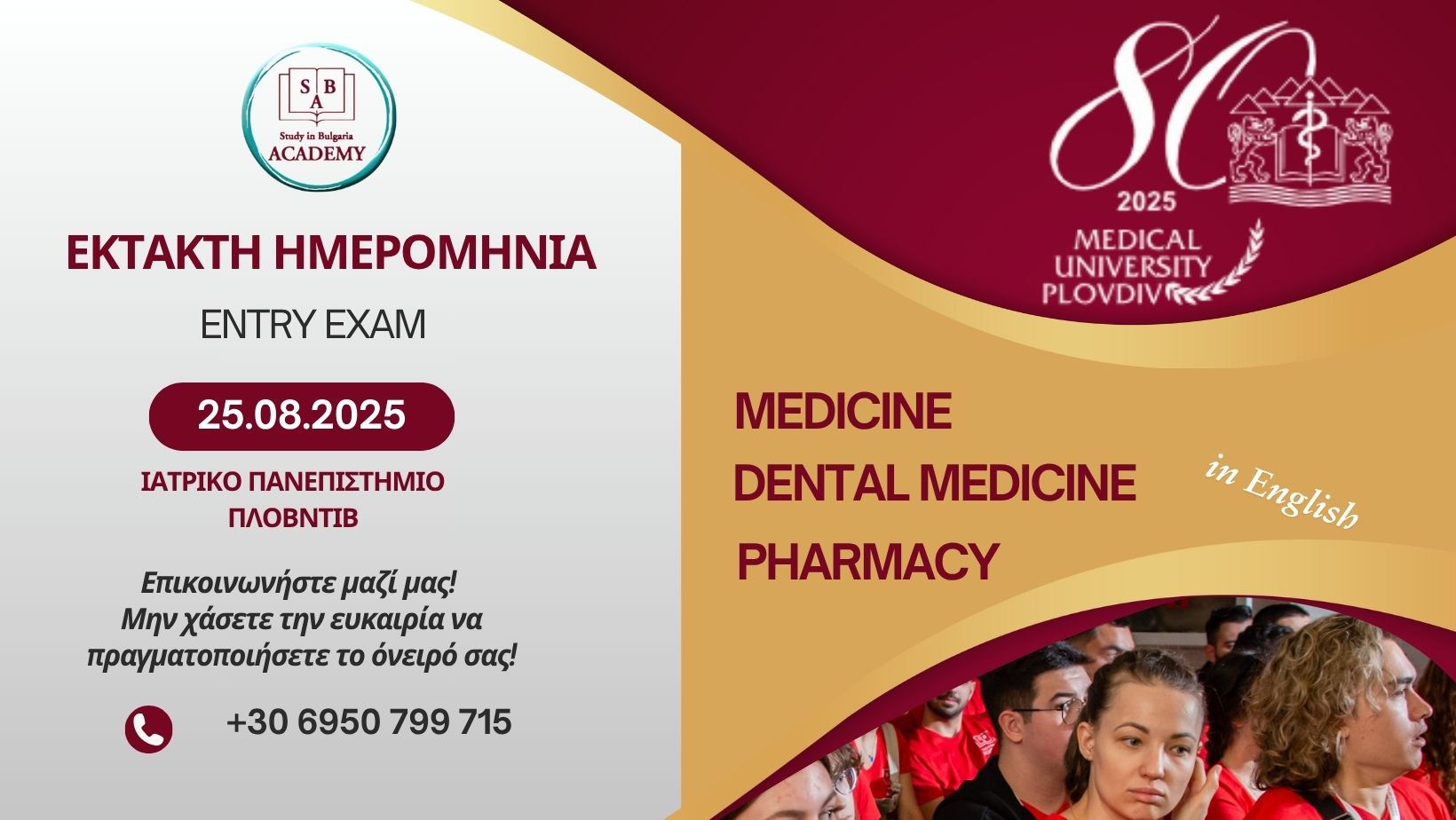
New Date of Entrance Examination at Plovdiv Medical University
Philippine Medical University Medical School Entrance Examination Plovdiv [...]
Latest News

Happy 8th of March to our students from Greece and Cyprus | SB-ACADEMY celebrates with you!
Happy 8th of March to our students from Greece and Cyprus SB-ACADEMY STUDY IN BULGARIA celebrates with you! Today, 8 March, we celebrate International Women's Day - a day dedicated to the [...]

Medical University of Plovdiv Entrance Examination – Medicine, Dentistry, Pharmacy 2025/2026
Philippine Medical University Medical School Entrance Examination Studies in Bulgaria - Medicine, Pharmacy, Dentistry in Plovdiv. Registration for the entrance exams to the Medical University of Plovdiv has started! As of [...]

Admission Examination Sofia Medical University – Medicine, Dentistry, Pharmacy 2025/2026
Entrance Examination Medical University of Sofia Studies in Bulgaria - medicine, pharmacy, dentistry in Sofia. Sofia Medical University has announced the date of the entrance examination for the academic year 2025/2026. [...]
Popular schools

MEDICINE
For all prospective students whose dream is to help their fellow human beings and study medicine, Bulgarian universities are one of the best options.

PHARMACEUTICALS
For those who wish to study pharmacy but have not yet chosen where you would like to study, SB-ACADEMY suggests you apply and study in Bulgaria.

ODONTIATRICS
Prospective students who dream of providing a beautiful and sparkling smile then dentistry is the right specialty. See more about dentistry.
Become one of the next successful graduates in Bulgarian universities
Contact the SB-Academy